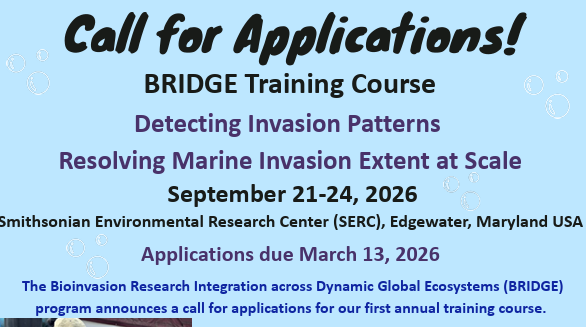
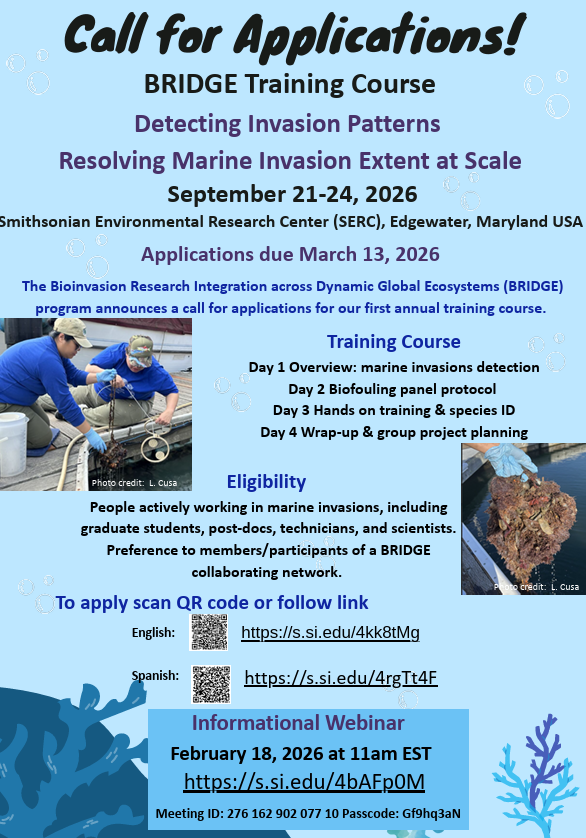
The Bioinvasion Research Integration across Dynamic Global Ecosystems (BRIDGE) program has announced a call for applications for its first annual training course, focused on detecting and resolving marine invasion patterns at scale.
Hosted by the Smithsonian Environmental Research Center in Edgewater, Maryland (USA), the four-day course will take place 21–24 September 2026 and will bring together researchers and practitioners working in marine invasions science.
Funded by the U.S. National Science Foundation (AccelNet) and hosted by the Smithsonian Institution, this course represents a major step forward in strengthening global collaboration and standardising approaches to marine bioinvasions research.
About the Course
Theme:
Detecting Invasion Patterns – Resolving Marine Invasion Extent at Scale
Participants will gain hands-on experience, methodological training, and opportunities for collaborative project development.
Training Overview
Day 1: Marine invasions detection – concepts and approaches
Day 2: Biofouling panel protocol
Day 3: Hands-on training and species identification
Day 4: Wrap-up and group project planning
The course aims to:
Standardise research methods
Coordinate experiments across networks
Train the next generation workforce
Mobilise science into action
Who Should Apply?
Applications are open to individuals actively working in marine invasions research, including:
Graduate students
Postdoctoral researchers
Technicians
Scientists
Preference will be given to members or participants of a BRIDGE collaborating network.
Informational Webinar
An informational webinar will be held on:
18 February 2026 at 11:00 AM EST
This session will provide further details about the course structure, expectations, and application process.
Application Deadline
Applications are due by 13 March 2026.
Applicants can apply via the official BRIDGE application link (see flyer for QR code and online form).